
Frauke Brinkmann
Strategic UX Leadership & Enterprise Product System Architecture for regulated multi-domain SaaS systems
Transforming complex digital product landscapes into coherent, scalable product ecosystems.
Contact01 — Executive Profile
Executive Profile · Product Systems Transformation
Enterprise Product Architecture · Product Systems Transformation · Experience Leadership · AI‑Enabled Product Development
Product design and systems architecture leader with 15+ years of experience shaping complex digital products, enterprise platforms and connected experiences, including regulated healthcare SaaS and multi-domain product environments. Combines end-to-end product experience leadership with enterprise-level architecture and infrastructure thinking, connecting human needs, business requirements, product semantics, technical implementation and governance into shared structures that enable products and organisations to evolve.
Her expertise extends from product discovery, experience strategy, information architecture, interaction design and usability validation to cross-domain product architectures, reusable product infrastructure, design systems governance and AI-enabled development workflows. Experienced in translating complex clinical, scientific, technical and organisational requirements into intuitive digital experiences and implementation-ready product structures. Works across Product, Engineering, UX, AI and Regulatory Affairs to align disciplines around shared product logic, reduce structural fragmentation and enable more consistent, scalable development. Her work addresses a fundamental challenge of growing product organisations: how to preserve product coherence while teams, technologies, domains and user needs continue to diversify.
Track record at a glance
15+ years · Regulated Healthcare SaaS · Clinical · Laboratory · Scientific · Enterprise
Manager Digital Product Design
Regulated Healthcare SaaS · since 2021Strategic UX responsibility in regulated, cross-domain enterprise healthcare SaaS.
Frontend and Design System Transformation
Shared React/MUI foundations, reusable components and cross-product standards.
A shared experience architecture for different product domains.
Systematic analysis of real architecture problems, decisions and governance structures.
Shared Reality (opens in a new tab)
Governed Product Infrastructure | React & Material UI Design SystemIndependently conceived and implemented, publicly verifiable Product Experience Infrastructure.
Long-standing hands-on product design and UX leadership experience.
Lecturer, IU International University
2023–2026Three years of teaching UX strategy, digital product design and design methodology at university level.
Certified Usability Engineer
IHK · Johner Institute (IEC 62366-1)Formal qualification in usability engineering and human factors for regulated medical software.
Diploma in Design and M.A. Digital Transformation
Dipl.-Des. (grade 1.0) · M.A. in progressDesign excellence combined with ongoing academic work on digital transformation.
From experience design
to product systems transformation
Frauke Brinkmann’s work operates across three connected dimensions:
- Product Experience Leadership
- Enterprise Product Systems Architecture
- Product Infrastructure & Transformation
Architecture made tangible
Frauke Brinkmann developed Integrity Architecture (opens in a new tab), an applied architectural model for maintaining coherence between product meaning, operational states, behaviour, technical implementation and governance. She also conceived, architected and built Shared Reality (opens in a new tab), an independently developed Product Experience Infrastructure that demonstrates how shared definitions, reusable experience structures, accessibility and governed implementation can operate as one connected system. Her professional Experience Cases complement these architectural initiatives by demonstrating the design and development of complex clinical, scientific and enterprise product experiences.
Frauke Brinkmann connects the design of exceptional product experiences with the architecture, infrastructure and development structures that make entire product ecosystems work.
Strategic Depth.
Execution Speed. Organizational Impact.
Combines enterprise-level architectural thinking with rapid, hands-on product delivery. Moves from concept to working prototypes in hours, establishes reusable design foundations in days, and develops governed product infrastructure where long-term scale demands it.
Extends this expertise through cross-functional team enablement and university teaching, translating complex concepts into practical capabilities and guiding hundreds of students through UX, UI design and real-world digital product development.
Credentials
- Strategic UX Leadership & Enterprise Product System Architecture
- Complex Multi-Domain Product & Experience Architecture
- Specialized in Regulated Healthcare SaaS & SaMD
- Certified Usability Engineer | IEC 62366-1 & ISO 9241-210
- Lecturer in UX Strategy & Digital Product Design | IU International University
- Design Systems as Infrastructure, AI Governance & Product Integrity
Selected Areas of Expertise
- Regulated Product Development
- Decision Architecture & Situational Awareness
- Enterprise Design Systems
- UX & Product System Architecture
- Semantic System Design
- AI-Supported Product Development
- Governance and Change Control
- Accessibility and Usability Engineering
- Product System Strategy
02 — Integrity Architecture
Architectural Innovation · Product System Integrity
Enterprise Product Architecture · System Integrity · Cross-Domain Governance · AI‑Enabled Product Development
Transforming fragmented product development into coherent, governable product systems.
Modern enterprises rarely struggle with a lack of digital products. They struggle with the growing complexity of keeping those products, their technologies and the organisations behind them aligned. As product portfolios expand, local decisions accumulate. Teams develop different interpretations of the same requirements. Interaction models diverge. Technical implementations drift. AI-assisted development accelerates experimentation while introducing new governance challenges. In regulated environments, the relationship between product behaviour, responsibility and evidence becomes increasingly difficult to maintain.
The challenge is no longer just designing better products. It is architecting the conditions under which entire product ecosystems can evolve without losing coherence.
A new architectural approach
to system integrity
Developed by Frauke Brinkmann, Integrity Architecture is an applied architectural model for governing the relationships between product meaning, operational states, interaction behaviour, technical implementation, decision structures and regulatory evidence. Rather than treating interfaces, design systems, software architecture and compliance as isolated concerns, the model connects them through explicit architectural relationships.
At its centre are Human Relevant States, operational states that matter for human understanding, decisions and responsibility. These states provide a common architectural reference across different forms of interaction. A person may act through an interface, an AI agent may propose a change, and a software service may execute an authorised transition. The representations and technologies differ, but the underlying product meaning, behavioural rules and accountability must remain coherent. Integrity is not achieved by making every product identical. It is achieved by preserving the relationships that allow different products and technologies to operate as one governable system.
From architectural principles
to operational transformation
Integrity Architecture translates this approach into concrete interventions across product development. Its six Architecture Case Studies address recurring structural challenges:
Regulated Enterprise Healthcare SaaS (SaMD), Multi-Domain Portfolio
Sole Digital Product Designer and Design System Owner, working with Product Management, Engineering and Regulatory Affairs
- 3.1AI GovernanceFrom AI Exploration to Governed Product DevelopmentEstablishing controlled boundaries between AI-supported exploration, product decisions and governed implementation. (password-protected, opens in a new tab)
- 3.2Product InfrastructureFrom Fragmented Implementation to Shared Product InfrastructureCreating reusable, versioned foundations that support coherent development across products and teams. (password-protected, opens in a new tab)
- 3.3Semantic ConnectivityFrom Tool-Specific Prototypes to System-Compatible ExplorationConnecting exploratory product concepts with shared semantic and implementation rules. (password-protected, opens in a new tab)
- 3.4Semantic ArchitectureFrom Runtime-Defined Logic to Explicit Semantic ContractsPreserving product meaning across design definitions, technical frameworks and runtime implementations. (password-protected, opens in a new tab)
- 3.5Behavioral IntegrityFrom Domain Fragmentation to Cross-Product CoherenceEstablishing consistent interaction and orientation principles while allowing domain-specific workflows. (password-protected, opens in a new tab)
- 3.6Regulatory EvidenceFrom Retrospective Evidence to Embedded TraceabilityConnecting tasks, risks, controls, evaluations and decisions through traceable product-development structures. (password-protected, opens in a new tab)
The case studies are password-protected. Access is available on request.
Request access to the case studies by emailTogether, these interventions demonstrate how architecture can change not only what organisations build, but how they define, develop, verify and govern complex products.
The enterprise value
Integrity Architecture (opens in a new tab) addresses the structural causes of duplicated work, inconsistent product behaviour, implementation ambiguity and fragmented accountability. It provides an architectural basis for greater cross-team alignment, controlled technology evolution, more reliable AI-supported development and traceable decisions. For regulated enterprise environments, it also creates a clearer relationship between product behaviour, risk controls and the evidence required to govern them.
The result is an architectural approach designed to reduce structural risk while enabling product organisations to scale complexity without multiplying fragmentation. Integrity Architecture represents Frauke Brinkmann’s original contribution to the evolution of complex digital product systems: moving from locally optimised products toward coherent, resilient and governable product ecosystems.
Perspectives & Publications
Rethinking Product Architecture for the AI Era
An ongoing article series exploring how AI, human judgment, product architecture and governance reshape complex digital product ecosystems. From Human Relevant States and semantic contracts to decision integrity and shared operational realities.
One architecture. Multiple product experiences.
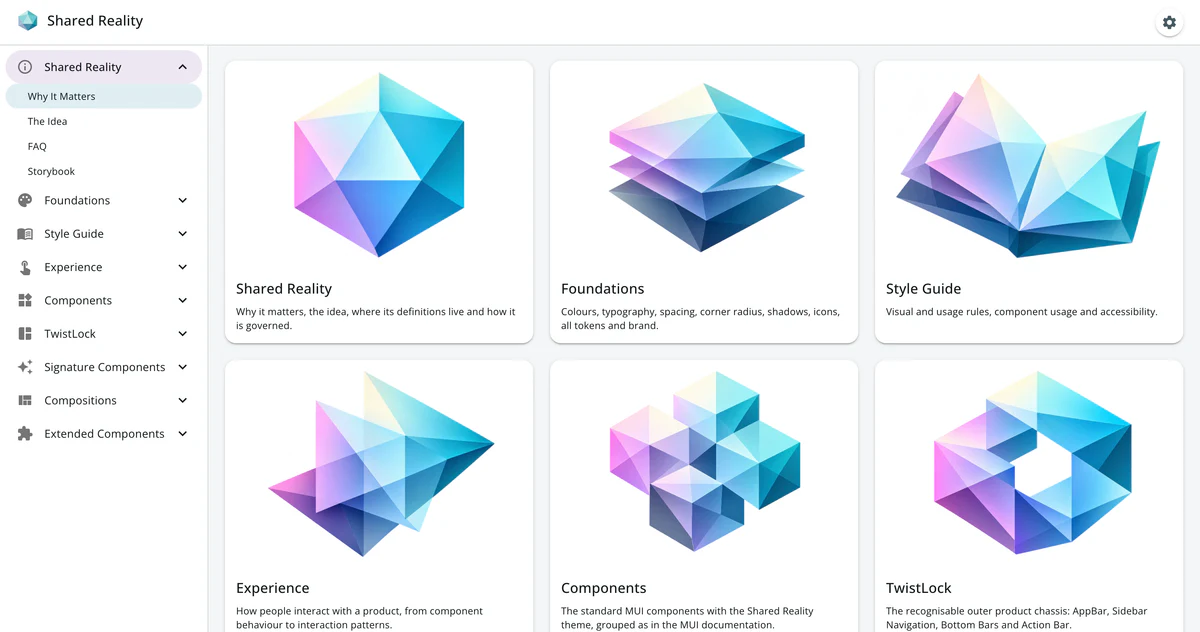
Shared Reality connects three essential dimensions of product experience:
Semantics
Define the meaning of interface elements, states and actions.
UI Architecture
Translates these definitions into design tokens, components, layouts and implementation structures.
Behavioral Experience
Establishes the interaction conventions that make products understandable, predictable and learnable across different contexts.
These dimensions are translated into working infrastructure through several distinctive architectural capabilities:
- TwistLockCross-Domain Product Architecture
- Signature ComponentsGoverned Interaction Hierarchy
- CompositionsReusable Product Capabilities
- Semantic FoundationsOne Source of Product UI Meaning
AI-enabled development
without architectural drift
Shared Reality integrates AI-assisted product development into a governed architectural model. Exploration remains deliberately open: teams and AI tools can experiment with different interaction concepts, component libraries and technical approaches. Product implementations follow the shared rules. Reusable solutions enter the design system only through explicit adoption, documented architectural decisions, verification and human approval.
Machine-readable instructions and component metadata make the infrastructure accessible to AI-assisted development tools while maintaining clear responsibility boundaries. Innovation can move quickly without allowing every experiment to redefine the product architecture.
Quality, accessibility and governance by design
Shared Reality embeds quality and traceability into the development infrastructure rather than treating them as separate downstream activities. Its working implementation includes shared semantic definitions, accessible component foundations, automated verification, documented architectural decisions, component lifecycle governance and traceable implementation rules.
Automated checks support quality assurance, while manual accessibility review and product-specific regulatory validation remain explicit responsibilities. This creates a foundation for controlled product evolution across technologies, teams and implementation contexts.
From systems thinking
to executable infrastructure
Shared Reality demonstrates Frauke Brinkmann’s ability to translate enterprise-level architectural thinking into working product infrastructure. Her contribution spans the complete development of the system: architectural concept, experience principles, semantic foundations, reusable UI structures, frontend implementation, documentation, verification and governance. It connects strategic product architecture with practical engineering decisions and the design of coherent human experiences.
Shared Reality is more than a design system. It is a working demonstration of how product architecture becomes scalable development infrastructure. It shows how organisations can move from repeated local design and implementation decisions toward shared product capabilities, creating the conditions for more coherent, efficient and governable product development.
04 — Enterprise Experience Cases soon
Professional Experience · Enterprise Product Design Leadership
Experience Strategy · Enterprise UX Architecture · Product Design Leadership · Human-Centered Design · Regulated Healthcare
Transforming complex workflows into intuitive, connected digital product experiences.
Across more than 15 years in digital product design, Frauke Brinkmann has worked on complex applications spanning healthcare, clinical operations, laboratory environments, scientific information systems and enterprise software. The Experience Cases present selected examples of complex product and UX work through independently reconstructed demonstrations. The reconstructed interfaces serve as contemporary visual demonstrations rather than reproductions of confidential employer-owned implementations.